
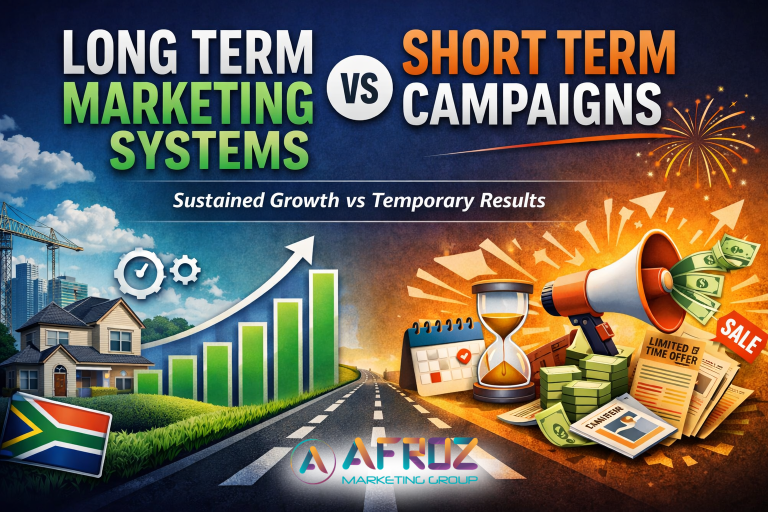
Long Term Marketing Systems vs Short Term Campaigns
Why This Debate Matters for Business Growth
Most businesses in construction, hardware, and real estate don’t struggle with marketing effort—they struggle with consistency.
One month, there’s a spike in leads.
The next, things go quiet.
This cycle is usually caused by relying on short term campaigns instead of building long term marketing systems.
Understanding the difference is not just strategic—it directly affects your revenue, pipeline stability, and long-term competitiveness.
What Are Long Term Marketing Systems vs Short Term Campaigns?
What are long term marketing systems?
Long term marketing systems are structured, ongoing processes that continuously generate leads, nurture prospects, and convert customers using multiple integrated marketing channels.
They are designed to:
Run continuously
Improve over time
Deliver predictable results
Scale with your business
What are short term campaigns?
Short term campaigns are time-bound marketing efforts aimed at achieving immediate results, such as promotions, launches, or limited-time advertising pushes.
They are:
Temporary
Focused on quick wins
Dependent on timing
Not inherently scalable
Key Difference: Systems Build Momentum, Campaigns Create Spikes
The core difference can be summarised simply:
Campaigns = short bursts of activity
Systems = ongoing growth engines
Campaigns can generate results—but they stop when the budget or effort stops.
Systems, on the other hand, continue to produce results because they are built to evolve and compound.
Why Long Term Marketing Systems Drive Better Results
1. Consistent Lead Generation
Businesses need a steady pipeline—not occasional bursts.
Long term systems provide:
Continuous inbound leads
Stable sales opportunities
Reduced dependency on timing
This is especially important in industries with longer sales cycles, such as construction and real estate.
2. Compounding Performance Over Time
Each month, a system becomes more effective:
SEO content gains rankings
Paid ads improve through data
Audiences become warmer
Conversion rates increase
Unlike campaigns, which reset after completion, systems build on previous performance.
3. Lower Cost Per Lead
Short term campaigns often require starting from scratch:
New targeting
New creatives
No optimisation data
Long term systems:
Reuse proven assets
Optimise continuously
Retarget engaged audiences
This reduces cost per lead significantly over time.
4. Stronger Brand Positioning
Visibility builds trust.
A business that consistently appears:
In search results
On social platforms
Through valuable content
Is perceived as more credible and established.
In property-driven industries, trust directly influences buying decisions.
5. Full Control of the Customer Journey
Systems guide prospects through a structured journey:
Awareness (search, ads, content)
Interest (education, case studies)
Consideration (comparisons, trust signals)
Decision (offers, consultations)
Campaigns typically focus only on the final step.
Industry-Specific Examples
Hardware Store
Campaign approach:
Monthly discounts
Flyers or boosted posts
System approach:
SEO targeting local search terms
Google Ads for high-intent buyers
Retargeting ads
Email promotions for repeat customers
Outcome:
Consistent foot traffic and higher repeat purchase rates.
Construction Company
Campaign approach:
Occasional social posts
Word-of-mouth reliance
System approach:
Project case studies
Lead capture forms
Google Ads for service searches
Automated follow-ups
Outcome:
More qualified leads and improved closing rates.
Real Estate Agency
Campaign approach:
Listing-based marketing only
System approach:
SEO for location-based searches
Paid ads for buyers and sellers
Email nurturing
Retargeting website visitors
Outcome:
A continuous pipeline of buyers and sellers.
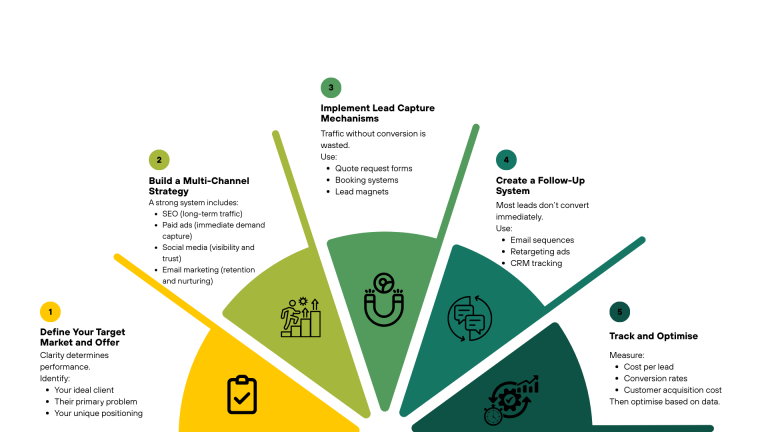
How to Build a Long Term Marketing System
Common Mistakes to Avoid
Relying Only on Campaigns
Leads become inconsistent and unpredictable.
Stopping Marketing After Results Drop
This resets progress, learning, and data.
Ignoring Follow-Up Systems
Most revenue is lost after the first interaction.
Expecting Immediate Results from Systems
Systems take time but outperform campaigns long term.
Using Only One Channel
This limits growth and increases risk.
Why This Matters in the South African Market
In cities like Pretoria:
Competition is increasing
Buyers are more informed
Decision cycles are longer
Businesses that rely on short term campaigns struggle to stay visible.
Those with systems:
Stay top-of-mind
Build trust over time
Capture demand consistently
The Afroz Marketing Approach
Afroz Marketing focuses on building structured, data-driven marketing systems tailored for:
Hardware stores
Construction companies
Real estate agencies
This includes:
Integrated SEO and paid advertising
Conversion-focused websites and funnels
Automated lead nurturing
Continuous performance optimisation
The focus is not on temporary wins—but on predictable, scalable growth.
Systems Create Stability, Campaigns Create Noise
Short term campaigns can generate attention.
But long term marketing systems create results that last.
The difference is:
Predictability vs uncertainty
Growth vs fluctuation
Strategy vs tactics
Businesses that invest in systems position themselves for sustained success.
Next Step
Evaluate your current marketing:
Are you generating consistent leads?
Do you have a structured system?
Or are you relying on campaigns alone?
The answer will determine your growth trajectory.
FAQs
What is the difference between long term marketing systems and short term campaigns?
Long term marketing systems are ongoing strategies designed to consistently generate leads, nurture prospects, and drive sales over time. Short term campaigns are temporary marketing efforts focused on immediate results, such as promotions or limited-time ads. The key difference is that systems create sustainable growth, while campaigns deliver short-term spikes in activity.
Why are long term marketing systems more effective than short term campaigns?
Long term marketing systems are more effective because they produce consistent lead flow, improve performance over time, and reduce cost per acquisition through data and optimisation. Unlike campaigns, which stop generating results once they end, systems continue to deliver value and build momentum.
How long does it take to see results from a marketing system?
Most businesses begin seeing measurable results from a marketing system within 3 to 6 months, depending on the channels used. Paid advertising can generate leads quickly, while SEO and content strategies take longer to build momentum but deliver stronger long-term returns.
What marketing channels should be included in a long term marketing system?
A strong marketing system typically includes SEO, Google Ads, social media marketing, email marketing, and conversion-focused websites or funnels. These channels work together to attract, convert, and retain customers across the full buyer journey.
How can construction, hardware, and real estate businesses generate consistent leads?
These businesses can generate consistent leads by implementing a structured marketing system that includes targeted SEO, paid advertising for high-intent searches, lead capture mechanisms, and automated follow-up processes. Consistency comes from integrating these elements into a continuous, data-driven strategy rather than relying on occasional campaigns.